How to tailor your resume in 7 steps
This is the method by hand. It takes 30 to 60 minutes the first time.
01Pick one posting
Choose the job you want most this week. Tailoring works one posting at a time, and the best one to start with is the one you care about.
02Pull out what it asks for
Copy the posting into a document and highlight every requirement: skills, tools, years, certifications, the size of the work (budgets, teams, volumes). Mark the 4 or 5 that appear first or more than once. Those are the ones the reader is screening for.
03Match each requirement to your evidence
Make a two column list. Left: the requirement. Right: the line on your resume that proves it, or a blank. Here is what that looks like for an Accounting Manager posting:
| The posting asks for | Your evidence |
| Own the month end close | Built a close checklist with owners and deadlines |
| Manage and develop staff | Review the work of 1 staff accountant; trained 2 new hires |
| ASC 606 revenue recognition | Blank. Manufacturing revenue, no ASC 606. |
| NetSuite administration | Saved searches and custom reports. Not admin. |
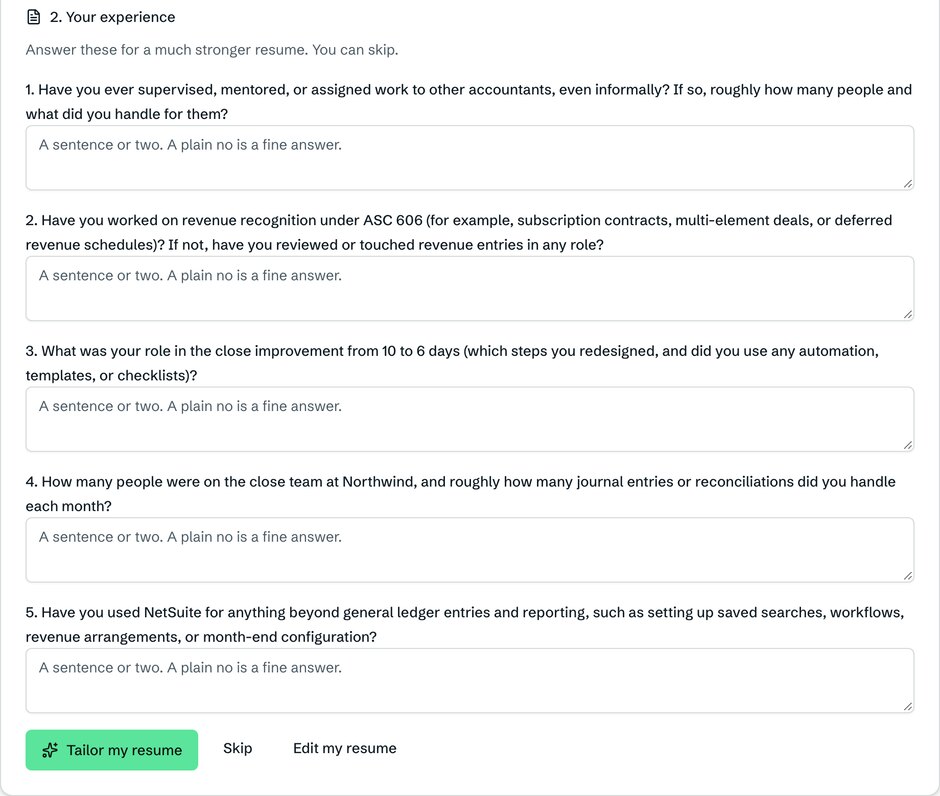
04Ask yourself about the gaps
Every blank on the right is a question. Have you done this, even partly, somewhere your resume does not mention? A project, a previous job, a course? A real yes becomes a new line. A real no stays off the page, and you know in advance what to say if it comes up in the interview.
This is the step most people skip, and it is where most of the improvement comes from. Your resume is usually missing things you have done, simply because you never thought to write them down.
05Rewrite the top third
The summary and the first role are what gets read. Rewrite your summary in 2 or 3 sentences that name the job title and the top requirements you meet. Put the most relevant skills first in your skills list, using the posting's spelling ("NetSuite", not "Net Suite").
06Reorder and trim the experience
Within each role, move the bullets that match the posting to the top. Rewrite them with the posting's words where they truly fit, and keep your real numbers. Cut or shorten bullets that do nothing for this job. One or two pages is plenty.
07Check every line before you send
Read the finished resume line by line and ask one question of each: could I talk about this for two minutes in the interview? If a number grew, put it back. If a skill slipped in from the posting that you do not have, take it out. Then save it as Word and PDF, named for the company and role.